
Common challenge
Teams look at Tolgee because it is open source and can be self-hosted. Then they find that self-hosting means running and upgrading a server, and that several features need a paid license.
ReRune gives teams comparing Tolgee a hosted localization workspace with CLI sync, AI assistance, translation variants, an MCP server, and OTA SDKs for React, React Native, Angular, Flutter, Android, and iOS. There is no server to operate and no license key to manage.
Teams look at Tolgee because it is open source and can be self-hosted. Then they find that self-hosting means running and upgrading a server, and that several features need a paid license.
Product and engineering teams that want their app to keep standard i18n, without operating localization infrastructure themselves.
Tolgee offers in-context editing for web apps, a content delivery CDN, and Android and iOS SDKs. ReRune adds a Flutter OTA SDK, translation variants for A/B tests, white-label brands, and plan-specific copy, publication rollback, and OTA staging previews.
Where ReRune goes further
Managing translations is only half the job. ReRune also controls what reaches your users, when, and for whom. Competitor notes reflect each vendor's public documentation in October 2026.
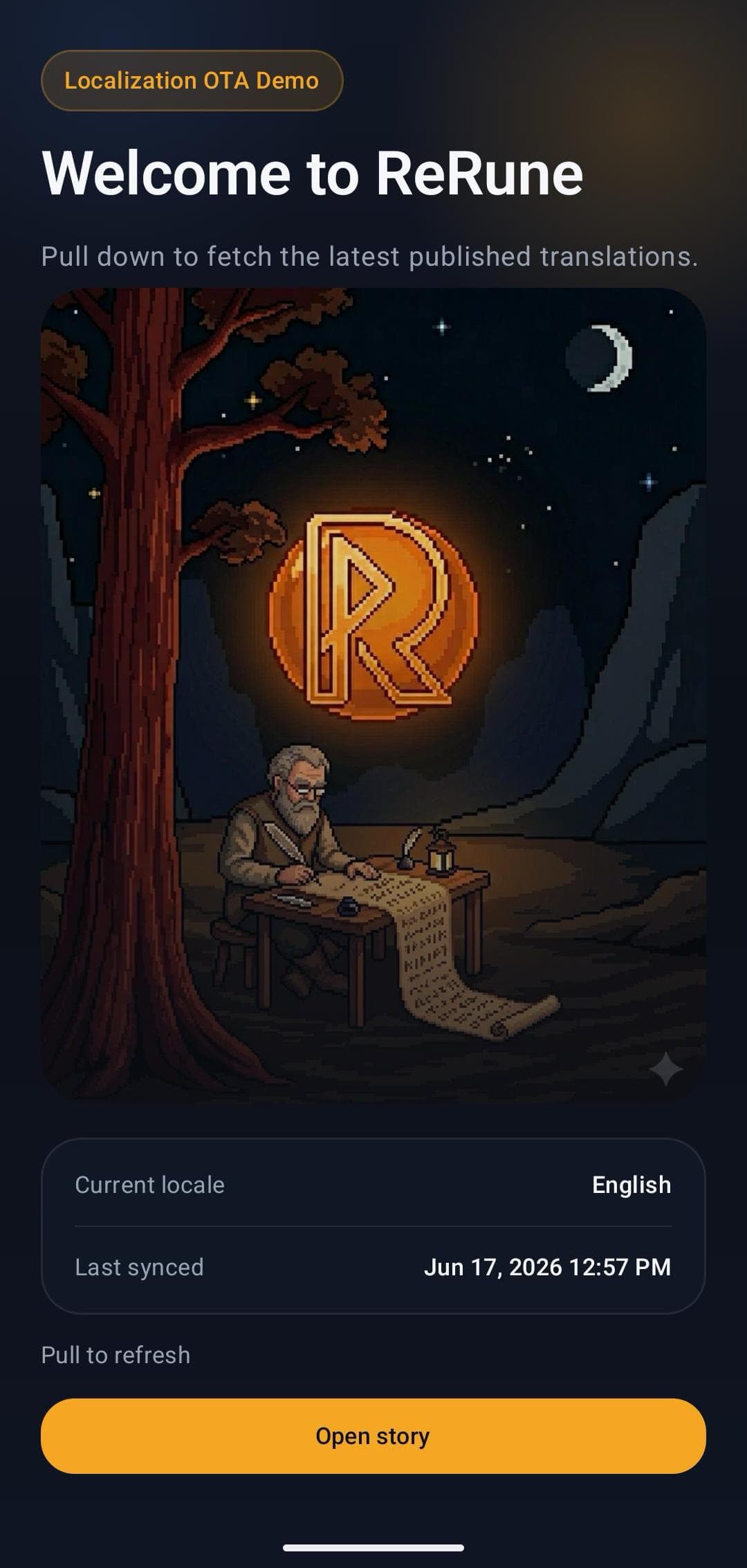
Publish a typo fix, a legal change, or a new language, and every supported app picks it up on its next update check. No store review, no redeploy. ReRune ships OTA SDKs for React, React Native, Angular, Flutter, Android, and iOS, each with an on-device cache and fallback to bundled strings.
Tolgee: OTA on Android, a manual remote fetch on iOS, and a CDN for web. Flutter gets ARB file support but no OTA SDK.
Turn on staging in a development or QA build to see saved drafts, unfinished translations, and new keys inside the running app. Production users keep the published text until you publish.
Tolgee: separate content delivery configurations, for example per branch, but no documented draft preview for test builds.
Every publication is kept. Preview an earlier snapshot and restore it to live apps, while the draft you are working on stays untouched.
Tolgee: its content delivery documentation does not describe restoring an earlier publication.
Store different messages under the same key for A/B tests, white-label brands, or Free and Pro plans. Your app picks the variant and Main text is the fallback, so there are no duplicated keys and no forked copy.
Tolgee: no documented audience variants. Custom values store key metadata, not alternative messages.
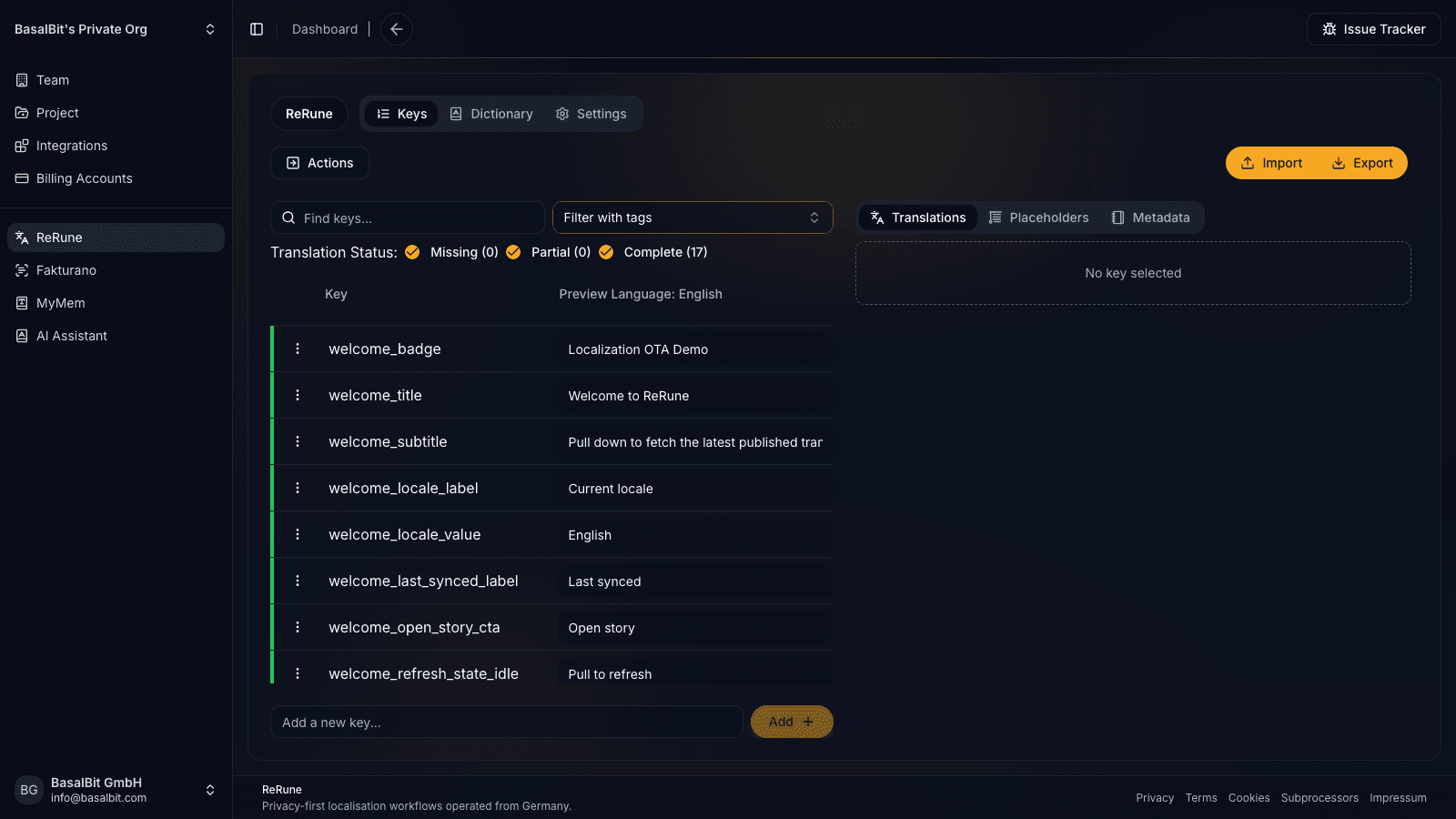
Set the preview language to the language you are working on and filter for keys not yet translated in it. Translators see exactly what is left, with no spreadsheets and no developer handoff.
Self-hosting vs ReRune
Tolgee's core is open source, but production use needs a server, a database, and someone who keeps both current. Tolgee Cloud removes that work, and paid ReRune plans start lower than paid Tolgee Cloud plans.
Self-hosted Tolgee runs as a Docker container with an external PostgreSQL database. Tolgee recommends 4 CPUs, 16 GB of RAM, and 20 GB of disk for the server.
Tolgee publishes new releases often. Someone on your team applies them, checks database migrations, backs up data, patches the host, and handles outages. With ReRune, that work is ours.
Tolgee's core is Apache-2.0, and the free self-hosted version allows up to 10 seats. SSO, granular permissions, webhooks, branching, and hosted content delivery need a paid license that Tolgee quotes on request.
Paid Tolgee Cloud plans start at €69 per month for 50,000 hosted words, which count the source text and every translation. Paid ReRune plans start at €19.95 per month including VAT for 2,000 translation keys, with unlimited languages and seats.
Switching
Tolgee exports translations in standard formats that ReRune imports, including JSON, XLIFF, Flutter ARB, Android XML, and Apple strings files. Web apps that use Tolgee's own React components or hooks move to standard i18next calls, which the ReRune SDK wraps.
ReRune wraps i18next and react-i18next, so your JSON catalogs and t() calls stay the same. ReRune.setup replaces i18n.init.
ReRune wraps ngx-translate or Transloco, so the translate and transloco pipes stay in your templates. ReRune.provide replaces the provider setup.
Flutter keeps gen-l10n ARB files and AppLocalizations, Android keeps strings.xml and getString, and iOS keeps NSLocalizedString. You add the ReRune setup call and a small platform hook.
Import existing files in standard formats such as ARB, strings.xml, Localizable.strings, XLIFF, and i18next JSON, then push and pull with the ReRune CLI. Your app keeps standard i18n, so your codebase is not tied to ReRune either.
Workflow
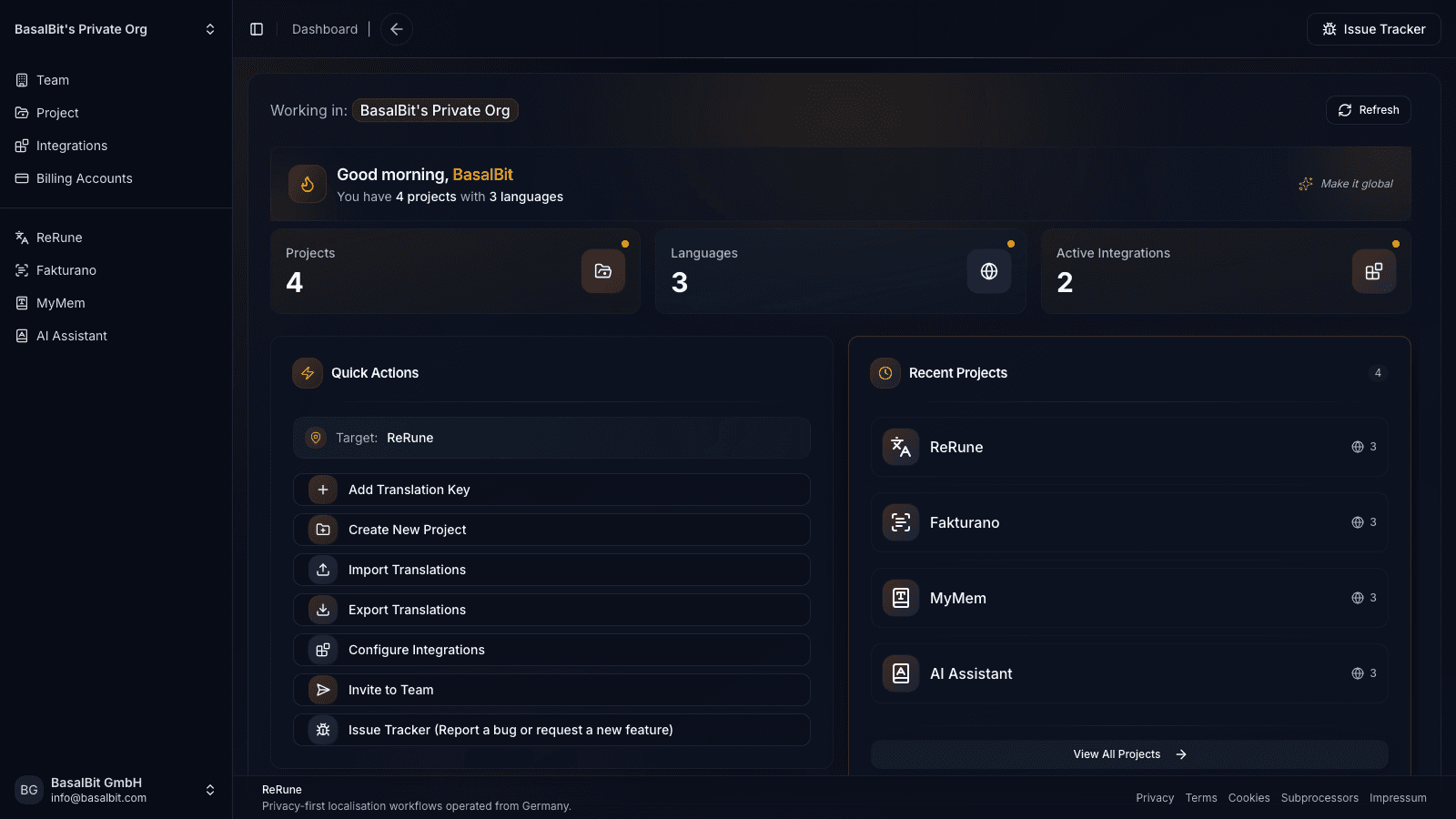
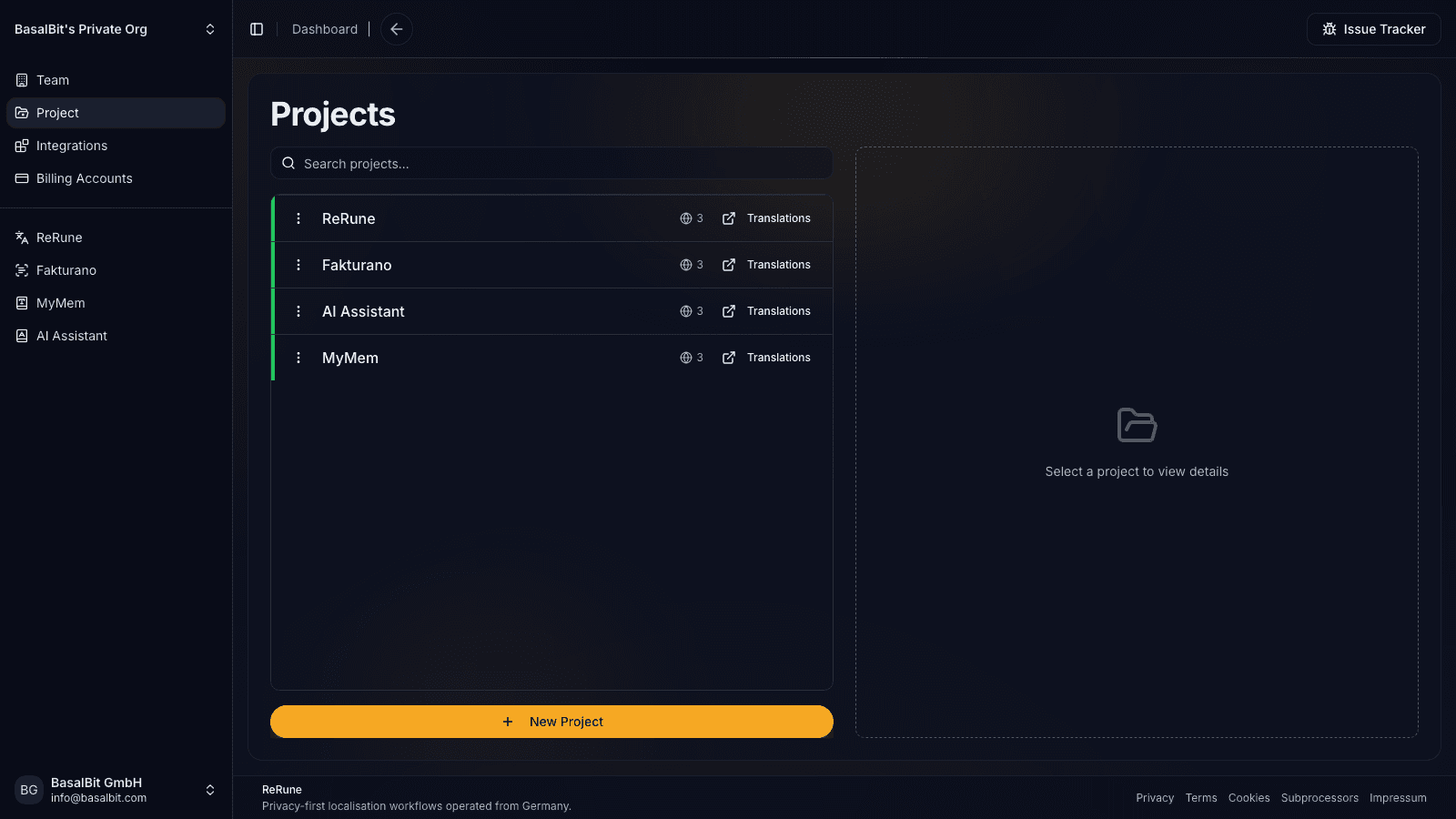
ReRune connects translation management to the delivery path developers already use: dashboard work, AI assistance, CLI/API sync, and OTA updates where a supported SDK is installed.
Manage keys, languages, values, placeholders, dictionaries, metadata, and project context before translation work spreads across files and messages.
Use DeepL or OpenRouter-assisted translation flows with dictionaries and product context close to the text being reviewed.
Use CLI/API workflows to move approved translations into repositories, CI/CD jobs, scripted release tasks, or custom platform integrations.
Export platform formats or publish OTA updates for supported SDKs while keeping bundled app resources as the safe fallback.
Setup WizardAI Coding Agent
Run the onboarding command from the root of your Git repository. The wizard inspects the app and confirms the plan with you, with no AI involved and nothing changed yet. Then it opens the coding agent you already use with a complete migration workflow.
Run inside your Git repository
$ curl -fsSL https://rerune.io/onboard.sh | shThe script runs locally. ReRune does not receive your source code or list of installed agents.
11 integrations: 4 available now, 7 planned.
 OpenCodeReady
 PiReady
Coverage
Start where localization creates release friction, then keep web, mobile, and cross-platform products in one shared workspace as your surface area grows.
Developer delivery
Use the ReRune CLI locally or in CI/CD to manage project translations, then deliver approved runtime updates through the SDK built for your app.
Companion CLI
Use the ReRune CLI to sync, validate, and manage translations right from your terminal. Run syncs in CI/CD or locally whenever you need to push a new language.
Homebrew (macOS/Linux):
brew install BasalBit/tap/rerunereruneConnect the project
Create the project config and connect the repository to its ReRune workspace.
rerune pullPull approved updates
Bring current dashboard translations into the app or its build workflow.
rerune pushPush local changes
Send local translation updates back to ReRune for the team to manage and publish.
SDK directory
Public ReRune SDKs for Flutter, Android, iOS, React, React Native, and Angular support runtime variant selection with Main and bundled fallback.
Flutter        rerune ^1.3.0
Android        rerune-android-compose:1.2.0
               rerune-android-views:1.2.0
iOS            ReRune 1.2.0
React          @rerune/react@1.6.0
React Native   @rerune/react-native@1.6.0
Angular        @rerune/angular@1.6.0
Questions
Share an idea, report a problem, or ask for help with ReRune.
No. ReRune is a hosted platform. Your app keeps standard i18n libraries such as i18next, ngx-translate, Transloco, Flutter gen-l10n, Android string resources, and NSLocalizedString, and you can export your translations at any time, so your codebase is not tied to ReRune. If you must run the platform on your own servers, self-hosted Tolgee is the better fit.
Tolgee Cloud prices paid plans by hosted words, which include the source text and every translation, starting at €69 per month for 50,000 words as listed on tolgee.io in October 2026. ReRune prices plans by translation keys and monthly OTA quota, with unlimited languages and seats, and paid plans start at €19.95 per month including VAT. Adding a language in ReRune does not move you to a higher plan.
You run the Tolgee container and an external PostgreSQL database, which Tolgee recommends sizing at 4 CPUs and 16 GB of RAM, and you keep both upgraded, backed up, and secure. The free self-hosted version allows up to 10 seats. SSO, granular permissions, webhooks, branching, and hosted content delivery need a paid license.
Export your Tolgee project in a standard format such as JSON, XLIFF, Flutter ARB, Android XML, or Apple strings, import it into ReRune, and point the ReRune CLI at the project. Web apps that use Tolgee's React components or hooks move to standard i18next calls, which ReRune wraps. Translation memory, glossaries, comments, and history move separately through exports.
ReRune focuses on software and app localization workflows for product and engineering teams. It does not aim to cover every enterprise content, agency, or language-service workflow.
Explore next
Go deeper into the developer, platform, and delivery workflows connected to this page.
Compare ReRune with self-hosted and hosted Weblate. ReRune is hosted, prices by translation keys with unlimited languages, starts at €19.95 per month, and ships OTA SDKs for web, mobile, and Flutter apps.
Read moreDeliver published app text through ReRune OTA SDKs, preview enabled drafts in staging clients, and keep production caches isolated with fallback and rollback.
Read moreDeveloper localization platform for app teams: translation management, CLI/API sync, AI assistance, and OTA SDK delivery where supported.
Read moreCreate projects, manage keys, use AI assistance with context, sync through CLI/API, and publish approved runtime updates when your app uses a supported ReRune SDK.